
Augmented Reality in Surgical Planning & Medical Education
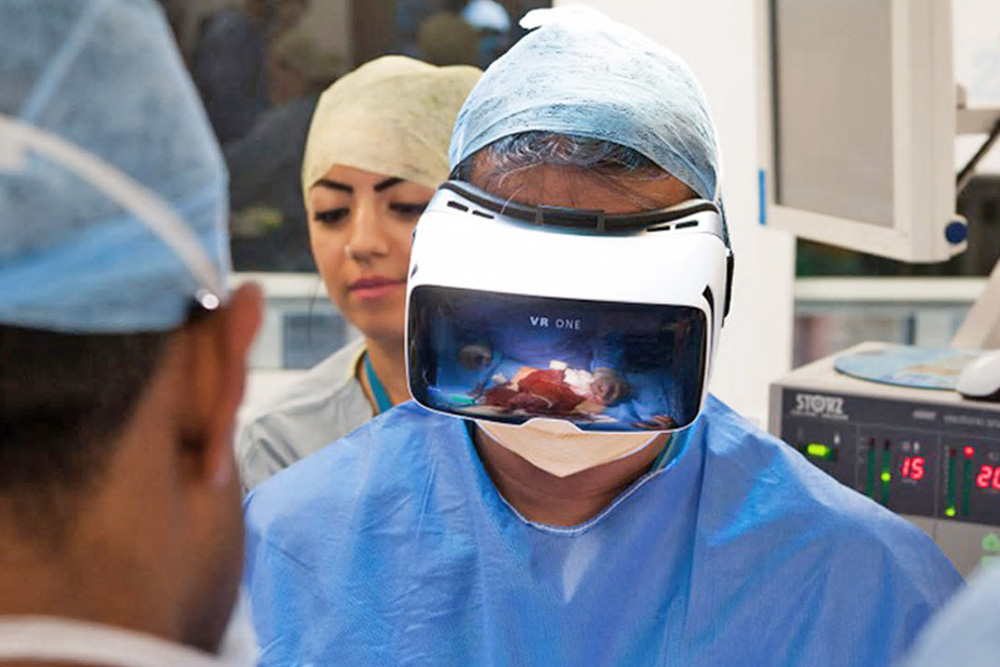
Augmented Reality (AR) is rapidly reshaping healthcare – particularly in surgical planning, intraoperative guidance, and medical education. By overlaying digital information such as three-dimensional anatomical models, surgical pathways, and real-time clinical data onto the physical world, AR enables surgeons, residents, and students to interact with patient-specific insights directly within their natural field of view.
Unlike traditional imaging workflows that rely on static images displayed on external monitors, AR places critical information in context – aligned with the patient, anatomy, and procedure itself. This contextual awareness enhances spatial understanding, supports faster clinical decision-making, and increases surgeon confidence during complex or high-risk scenarios.
As healthcare systems continue to pursue greater precision, safety, efficiency, and consistency of outcomes, AR is emerging as a foundational technology at the intersection of clinical innovation, digital transformation, and modern medical training.
What Is Augmented Reality in Healthcare?
In healthcare, augmented reality refers to technologies that overlay computer-generated content onto a real-world clinical environment. These systems are typically delivered through:
- Head-mounted displays (HMDs)
- Tablets or smartphones
- Projection-based or spatial computing interfaces
Unlike virtual reality (VR), which immerses users in a fully simulated environment, AR enhances the real world with contextual digital information. This distinction makes AR particularly well suited for operating rooms, procedural suites, and clinical classrooms – settings where situational awareness, precision, and real-time interaction with patients and equipment are essential.
In modern healthcare environments, AR is commonly used to:
- Visualize complex anatomy in three dimensions
- Support surgical and interventional procedures
- Simulate operations and clinical workflows
- Train clinicians without removing them from real-world contexts
AR for Surgical Planning: Improving Precision Before Surgery
Enhanced Anatomical Visualization
One of the most impactful applications of AR in healthcare is preoperative surgical planning. Using imaging data from CT scans, MRIs, and other modalities, surgeons can convert patient anatomy into interactive, three-dimensional models that are superimposed directly onto the body or surgical field.
This approach dramatically improves understanding of spatial relationships between organs, blood vessels, nerves, and pathological structures. The benefits are especially pronounced in specialties such as neurosurgery, orthopedics, cardiovascular surgery, and oncology, where millimeter-level precision can significantly influence outcomes.
By allowing surgeons to explore anatomy dynamically – rotating, isolating, or highlighting structures – AR reduces uncertainty and enhances procedural preparedness before a single incision is made.
Real-Time Guidance and Risk Reduction
Beyond preoperative planning, AR can also support surgeons during live procedures by providing real-time visual guidance. Critical structures – such as tumor margins, vascular pathways, or implant alignment – can be projected directly into the surgeon’s field of view, reducing reliance on memory or frequent glances at external displays.
Studies of AR-assisted surgical techniques have associated these systems with:
- Reduced operative time
- Lower intraoperative blood loss
- Improved accuracy and consistency
Importantly, the U.S. Food and Drug Administration (FDA) has begun clearing AR-based surgical navigation systems, signaling growing regulatory confidence in the safety and clinical value of these technologies.
AR in Surgical Education and Training
Accelerating Skill Development
AR is transforming surgical education by enabling medical students and residents to practice procedures using guided overlays, step-by-step prompts, and real-time feedback. These immersive learning environments help bridge the gap between theoretical instruction and hands-on clinical experience.
Rather than passively observing procedures, learners actively engage with anatomy, instrumentation, and surgical workflows in a way that mirrors real-world practice – without compromising patient safety.
A systematic review published in peer-reviewed medical literature found that trainees using AR experienced:
- Approximately 35% improvement in technical performance
- Nearly 30% higher task accuracy
- Significant gains in procedural knowledge compared to traditional training methods
Evidence-Based Educational Benefits
Additional research continues to support AR’s role in medical education:
- Reviews of multiple clinical studies show improved learning outcomes in the majority of AR-assisted training scenarios
- Research published in Surgical Endoscopy demonstrated that AR-assisted learners achieved higher performance scores while experiencing reduced cognitive load
- AR-based simulations have been shown to accelerate competency development while standardizing training experiences across institutions
Market Growth and Adoption Trends
The increasing adoption of AR in healthcare is reflected in strong market growth. Global projections estimate that the healthcare AR market will grow from approximately USD 1.5 billion in 2025 to nearly USD 5 billion by 2030.
Surgical planning and intraoperative visualization are among the fastest-growing segments, as hospitals and health systems seek technologies that:
- Improve clinical outcomes
- Reduce complications and variability
- Support efficiency without increasing staff burden
As reimbursement models continue to emphasize value-based care, AR’s ability to enhance precision and reduce risk is driving broader institutional investment.
Remote Collaboration and Telementoring
AR also enables remote surgical collaboration by allowing multiple clinicians to view the same augmented surgical field simultaneously. Specialists can provide real-time guidance, annotations, and recommendations from anywhere in the world.
This capability supports:
- Telementoring for early-career surgeons
- Remote second opinions during complex cases
- Expanded access to specialized expertise for rural or underserved healthcare systems
Challenges and Future Outlook
Despite its promise, AR adoption in surgery is not without challenges. Key considerations include:
- The need for standardized clinical validation and long-term outcome data
- Integration with existing hospital IT systems and imaging workflows
- Demonstrating clear cost-effectiveness at scale
Critical reviews in leading surgical journals emphasize the importance of rigorous evidence and thoughtful implementation to ensure AR technologies deliver measurable clinical value.
As hardware becomes lighter and more ergonomic – and software platforms more interoperable – AR is expected to evolve from an emerging innovation into a standard component of surgical infrastructure.
Conclusion
Augmented Reality is redefining how surgeons plan procedures and how future clinicians are trained. By seamlessly combining real-world environments with digital intelligence, AR enhances visualization, accelerates learning, and supports safer, more precise surgical care.
With growing clinical evidence, regulatory momentum, and strong market adoption, AR is positioned to play a central role in the future of surgical planning, medical education, and patient-centered care.